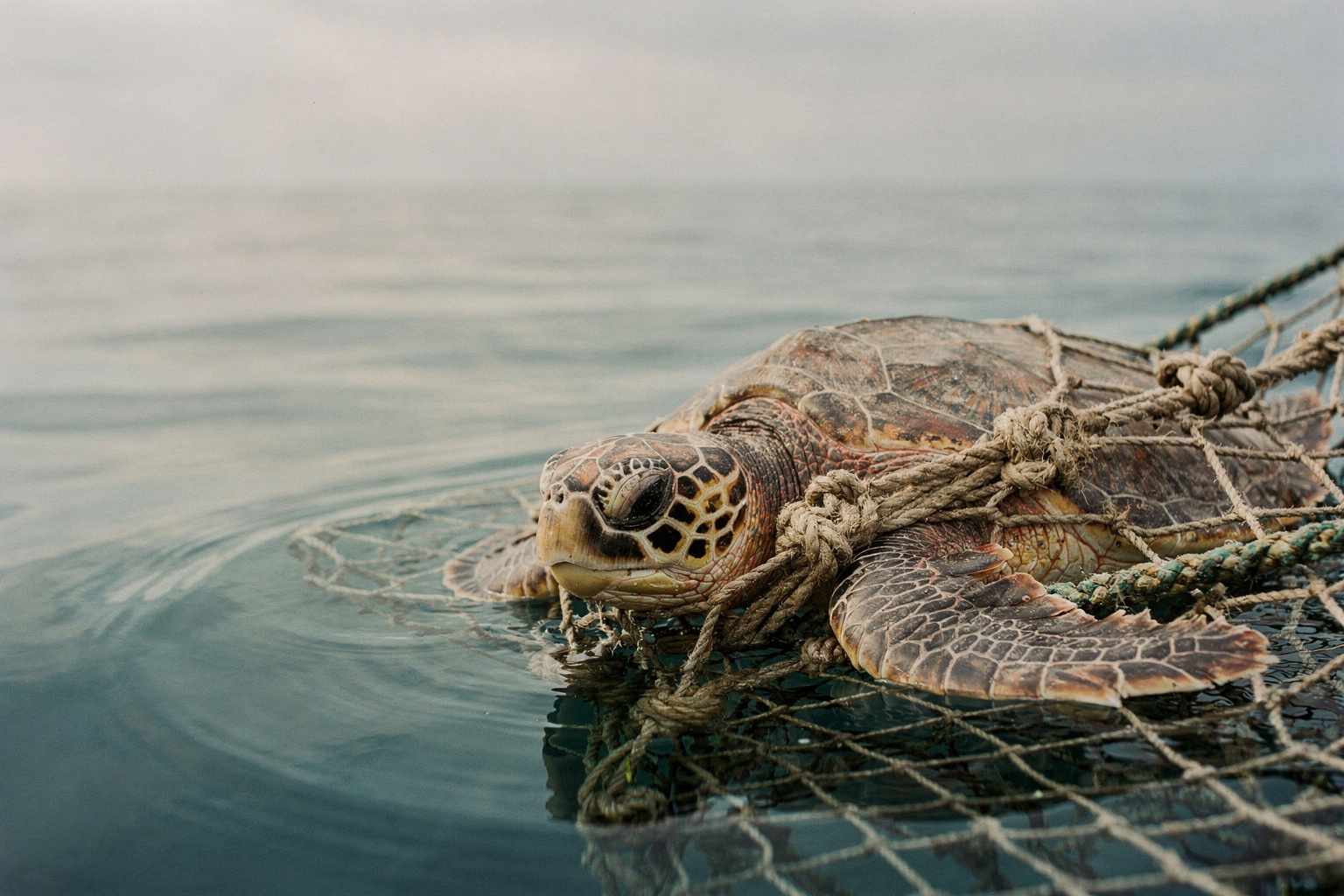
Bycatch — dolphins, turtles and sharks killed by fishing — is not a sad inevitability of feeding the world. It is a predictable, measurable and often subsidised consequence of industrial fishing gear operated in the full knowledge of what it kills. The question is not whether bycatch can be reduced, but why it has not been.
How big is the bycatch problem — and who is most affected?
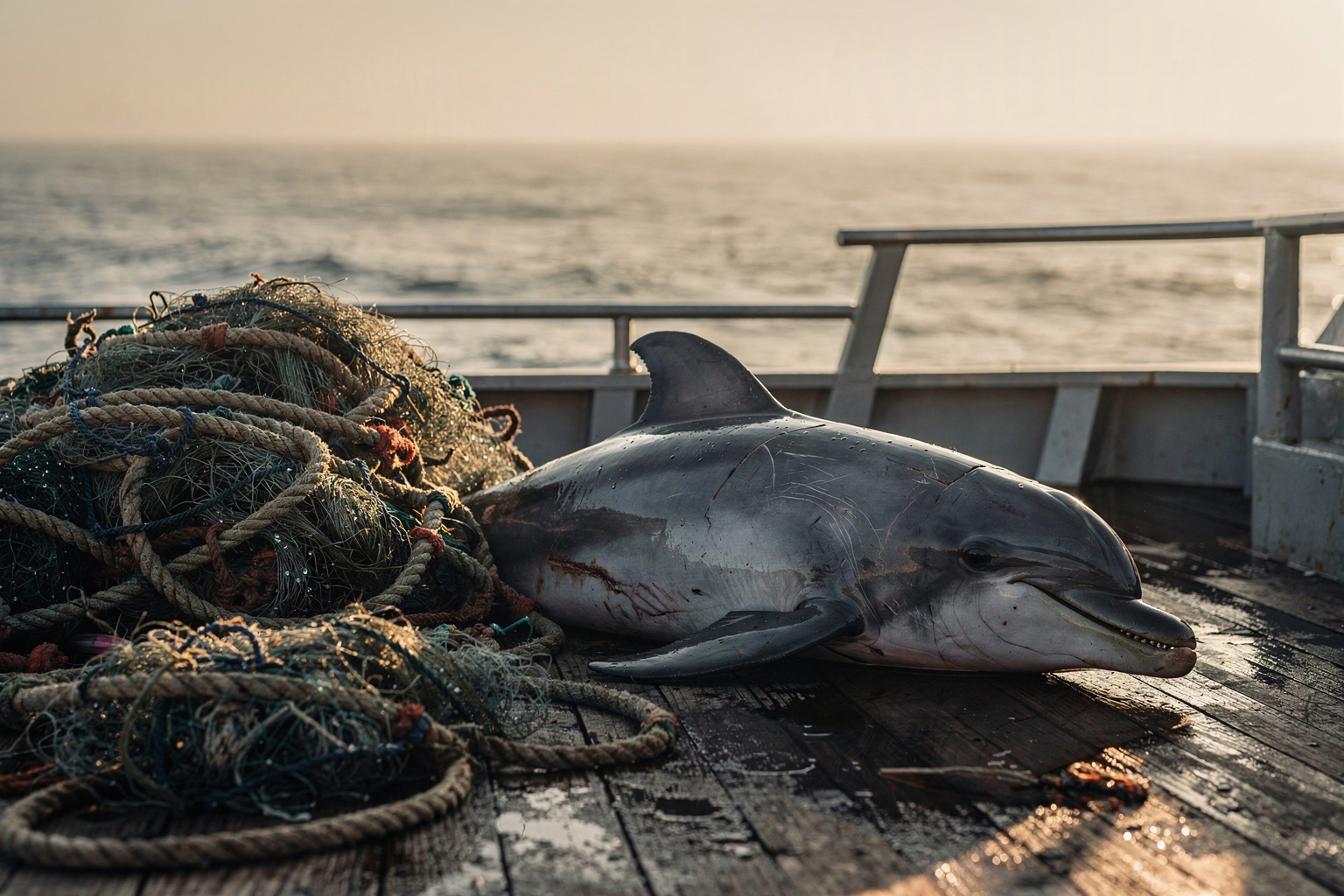
The global scale of bycatch is enormous, though estimates vary by species and gear type. A 2023 review in the journal Ocean & Coastal Management estimated that between 300,000 and 500,000 cetaceans (whales, dolphins, porpoises) are killed annually in fishing nets. Sea turtle bycatch is estimated at over 250,000 per year, with the majority in shrimp trawls and longlines. Shark mortality from bycatch alone exceeds 100 million individuals annually, according to a 2021 study in Nature.
Geographically, the problem is concentrated in regions with high fishing intensity and weak regulation. In the North Atlantic, harbour porpoise bycatch in gillnets is a persistent issue for UK and Irish fleets. In the Mediterranean, the critically endangered Balearic shearwater is frequently caught by longlines. In the Indian Ocean, shark bycatch from tuna longliners has driven several species to the brink. Off West Africa, illegal and unreported fishing by foreign trawlers kills thousands of sea turtles and dolphins that would otherwise support coastal food security.
| Species group | Estimated annual deaths | Primary gear | Population trend |
|---|---|---|---|
| Cetaceans (dolphins, porpoises) | 300,000–500,000 | Gillnets, purse seines | Declining in 60% of assessed populations |
| Sea turtles | 250,000+ | Shrimp trawls, longlines | Six of seven species threatened |
| Sharks and rays | 100,000,000+ | Longlines, gillnets | Over one-third threatened with extinction |
| Seabirds | 160,000–320,000 | Longlines, trawls | Declining in 70% of monitored colonies |
What is the fishing industry's defence — and does it hold?
The strongest argument for the industry is that bycatch is often economically necessary: small-scale fishers in developing nations cannot afford selective gear, and any reduction in catch threatens livelihoods. Fishing fleets also argue that bycatch is unavoidable in mixed-species fisheries, where target and non-target species swim together. In the North Sea, for example, cod and haddock are caught alongside each other, and fishers claim that excluding one would require closing the entire fishery.
There is also the argument that seafood provides essential protein. The FAO estimates that fish provides about 20% of animal protein intake for 3.1 billion people. For coastal communities in India, Indonesia, and West Africa, fishing is not a luxury but a food security strategy. The case against bycatch, the industry says, must consider the human cost of reducing catches.
These are fair points. Industrial fishing does employ millions and feed billions. But the industry's defence rests on two questionable premises: that bycatch is unavoidable, and that the only alternative is collapse. Neither holds up to scrutiny.
The strongest rebuttal: bycatch is a choice, not a necessity
The empirical evidence is clear: bycatch can be drastically reduced with existing technology at low cost. Turtle excluder devices (TEDs) reduce sea turtle bycatch in shrimp trawls by up to 97% with minimal loss of target catch, according to the US National Oceanic and Atmospheric Administration (NOAA, 2022). Acoustic pingers on gillnets reduce dolphin and porpoise bycatch by over 50%, as demonstrated in a 2020 study in the Journal of Applied Ecology. Bird-scaring lines on longliners cut seabird mortality by 80–90%, according to BirdLife International (2021).
The problem is not that solutions don't exist. It's that they aren't adopted. Only 24 countries mandate TEDs. Observer coverage on global fishing vessels is under 5%, meaning most bycatch is never counted. This is not a tragedy of the commons; it is a governance failure enabled by subsidies. Global fisheries subsidies totalled $35 billion in 2021, with $22 billion going to fuel and capacity-enhancing subsidies that effectively pay fleets to continue fishing unsustainably, according to the OECD.
“Bycatch is the single biggest threat to many marine vertebrate populations, and it is almost entirely unregulated on the high seas. We have the technology to solve most of it — we lack the political will to enforce it.”
Furthermore, the food security argument obscures who benefits. Industrial fleets operating in West African waters often export their catch to Europe and Asia, while local communities lose the protein that bycatch and overfishing remove from their waters. A 2021 study in Marine Policy found that foreign fleets in West Africa catch over 3 million tonnes annually, much of it bycatch of species that local fishers depend on. The industry's defence protects profit, not people.
What can consumers do about bycatch?
Most consumers cannot trace their seafood back to a specific vessel. But they can make choices that reduce demand for the worst bycatch fisheries. While no seafood is bycatch-free, some options are less harmful than others — and reducing seafood consumption altogether is the most reliable way to shrink the industry's impact on marine wildlife.
The table below compares common seafood choices by their bycatch risk. As with all fishing, the only way to eliminate bycatch entirely is to stop eating fish. But if you do eat seafood, these options are ranked from highest to lowest risk.
| Seafood type | Typical gear | Bycatch risk | Notes |
|---|---|---|---|
| Imported shrimp (trawled) | Bottom trawl | Very high | Sea turtle and juvenile fish bycatch |
| Tuna (longline) | Longline | High | Sharks, seabirds, sea turtles |
| Salmon (farmed) | Net pens | Moderate | Wild fish used in feed, escapes |
| Sardines/anchovies (purse seine) | Purse seine | Low | Small cetacean bycatch possible |
| Plant-based seafood alternatives | None | None | No bycatch; recommend as substitute |
Dolphin bycatch in gillnets: reduction with acoustic pingers
How to reduce your bycatch footprint
How to reduce your bycatch footprint
- 1
Check the origin and gear type
Use the Seafood Watch guide or MSC label to avoid longline and trawl fisheries. Choose purse seine or handline where available.
- 2
Avoid imported shrimp
Imported shrimp is often trawled without TEDs. If you must buy shrimp, choose US or Australian wild-caught with TEDs mandated.
- 3
Reduce overall seafood consumption
Substitute one seafood meal per week with a plant-based protein like lentils, tofu, or chickpeas. This reduces demand for industrial fishing.
- 4
Support campaigns for observer coverage
Back organisations like Oceana and Greenpeace calling for 100% observer coverage on fishing vessels. Write to your MP or representative.
- 5
Ask supermarkets for bycatch policies
Major retailers like Tesco, Walmart, and Loblaws control supply chains. Demand they publish bycatch data for their seafood.
- 6
Push for subsidies reform
The WTO has agreed to curb harmful fisheries subsidies, but ratification is incomplete. Support MPs who back the agreement.
Where that leaves us
The case against bycatch is not a case against fishers. It is a case against a system that treats the deaths of hundreds of thousands of dolphins, turtles, and sharks as an acceptable externality. The industry's defence — that bycatch is unavoidable, that livelihoods depend on it, that technology is too expensive — does not withstand the evidence. Solutions exist, they are cheap, and they work. What is missing is enforcement and the political will to confront a heavily subsidised industry.
Consumers can accelerate change by reducing seafood demand, choosing lower-bycatch options, and demanding transparency. But the ultimate fix is regulatory: mandatory observer coverage, universal TEDs, acoustic pingers, and an end to capacity-enhancing subsidies. Until then, every seafood meal carries a hidden cost measured in dolphin dorsal fins, turtle shells, and shark fins. The alternative — plant-based protein — is cruelty-free, bycatch-free, and increasingly affordable.
Frequently asked questions
What is bycatch in fishing?+
Bycatch is the accidental capture of non-target species — dolphins, sea turtles, sharks, seabirds, and juvenile fish — in fishing gear. Most bycatch is discarded dead or dying. It is a leading cause of marine wildlife decline, with over 100 million sharks and 300,000 cetaceans killed annually according to FAO and WWF estimates.
Is bycatch illegal?+
In some countries, yes. The US Marine Mammal Protection Act sets bycatch limits, and the EU has a bycatch ban for certain species. But enforcement is weak. Less than 5% of global fishing vessels carry observers, so most bycatch goes unrecorded. On the high seas, regulation is nearly absent.
How can I avoid seafood that causes bycatch?+
Choose seafood caught with purse seines or handlines rather than longlines or trawls. Avoid imported shrimp. Reduce overall seafood consumption and replace it with plant-based proteins like beans, tofu, or lentils. Consumer pressure on supermarkets is also effective.
Do turtle excluder devices work?+
Yes. TEDs reduce sea turtle bycatch in shrimp trawls by 90–97% with minimal loss of target catch, according to NOAA. They are mandatory in the US, but only 24 countries require them, and enforcement is limited in international waters.
Which fish have the highest bycatch?+
Imported shrimp from bottom trawls has the highest bycatch rate, killing sea turtles and juvenile fish. Longline-caught tuna and swordfish also have high bycatch of sharks and seabirds. Sardines and anchovies from purse seiners have lower bycatch risk, though not zero.