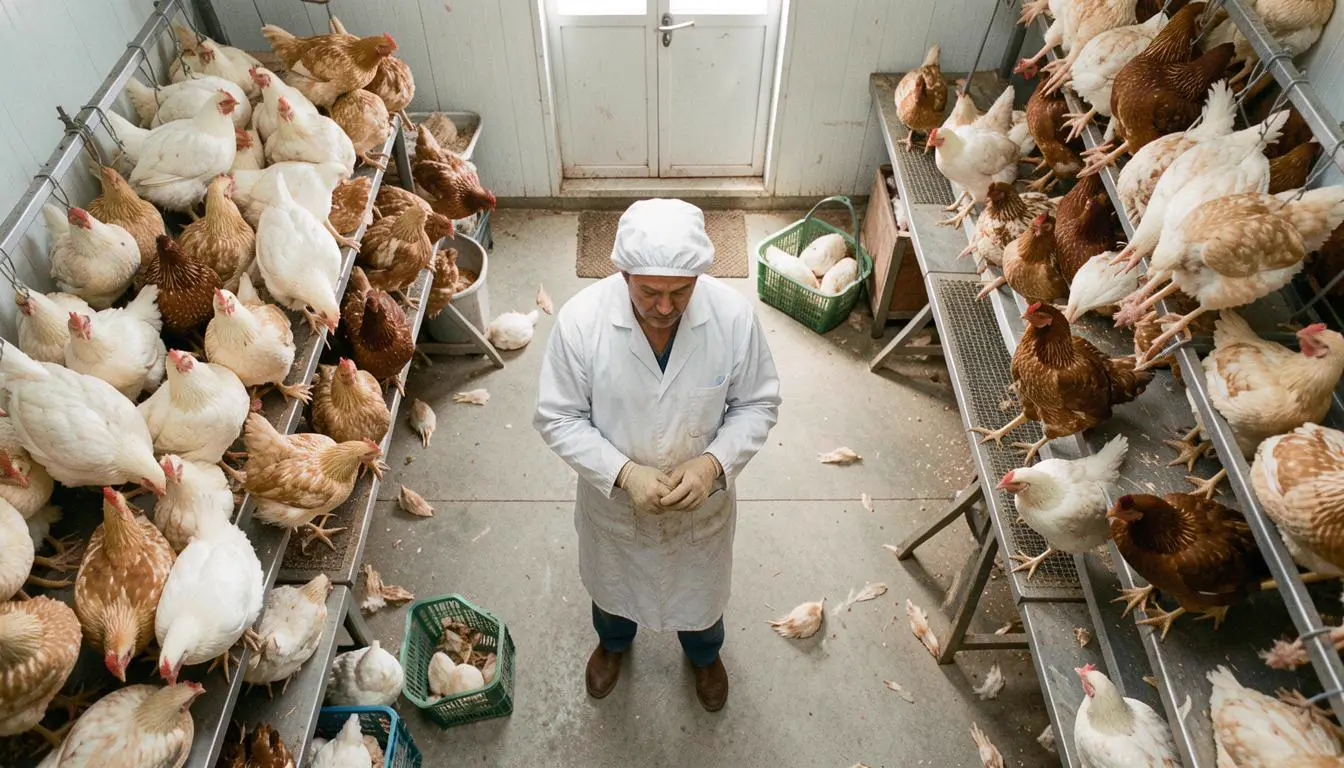
Slaughterhouse worker conditions in the United States are not merely an occupational safety issue; they represent a profound intersection of labor exploitation, racial hierarchy, and industrial animal agriculture. Workers in meatpacking and poultry plants—disproportionately Black, Latino, and immigrant—face injury rates higher than any other manufacturing sector, with wage theft, union suppression, and retaliation as standard practice. This manifesto argues that the fight for animal liberation is inseparable from the fight for racial and labor justice, and that dismantling factory farming requires centering the workers who bear its harshest costs.
How do injury rates in slaughterhouses compare to other dangerous industries?
Meatpacking is consistently ranked as one of the most dangerous occupations in the United States. According to the Bureau of Labor Statistics (2023), the incidence rate of nonfatal occupational injuries and illnesses in animal slaughtering and processing was 5.5 cases per 100 full-time workers—more than double the private industry average of 2.2. This rate exceeds that of construction (2.3), mining (1.7), and even firefighting (4.1). Repetitive motion injuries, such as carpal tunnel syndrome, affect an estimated 40% of poultry workers annually (NIOSH, 2019).
“The line speed in a modern slaughterhouse can reach 1,400 head of cattle per shift, or 175 birds per minute. At those speeds, workers are reduced to machine appendages, and injury becomes a statistical certainty.”
| Industry | Injury Rate per 100 Workers | Median Annual Wage |
|---|---|---|
| Animal slaughtering/processing | 5.5 | $30,000 |
| Construction | 2.3 | $48,000 |
| Mining | 1.7 | $59,000 |
| Firefighting | 4.1 | $51,000 |
| Private industry average | 2.2 | $46,000 |
What is the racial composition of the slaughterhouse workforce, and why does it matter?
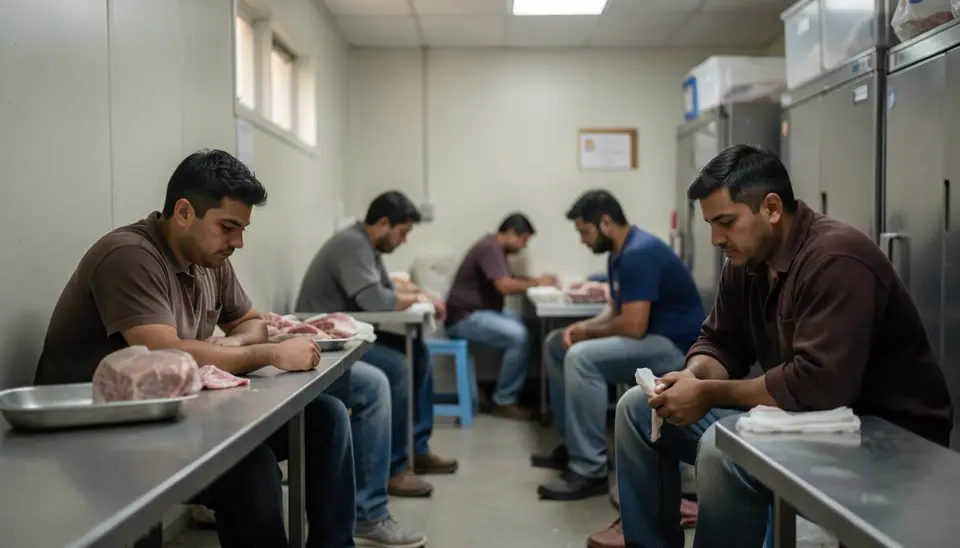
The meatpacking workforce is overwhelmingly composed of people of color. Data from the Economic Policy Institute (2022) shows that Black and Latino workers constitute 62% of all meatpacking employees, compared to 28% of the overall private-sector workforce. In poultry processing, the proportion is even higher: 75% of workers are Latino, many of them immigrants from Mexico and Central America. This racial stratification is not accidental. Employers actively recruit from marginalized communities, often targeting refugee populations (e.g., Somali and Burmese workers in Minnesota) and undocumented immigrants who are less likely to report violations for fear of deportation.
Share of workers of color in US meatpacking vs. all private industry, 2022
How does immigration status amplify exploitation in slaughterhouses?
Immigration status is a critical axis of vulnerability. Undocumented workers, who make up an estimated 20-30% of the meatpacking workforce (Pew Research Center, 2020), face a triple bind: they are excluded from most labor protections under the National Labor Relations Act, they fear retaliation from employers who threaten to call Immigration and Customs Enforcement (ICE), and they lack access to workers' compensation due to fear of exposure. In a 2023 study by the Southern Poverty Law Center, 68% of surveyed slaughterhouse workers reported wage theft (e.g., unpaid overtime, missing breaks), yet only 12% filed a complaint. The threat of deportation is wielded as a disciplinary tool, suppressing wages and preventing collective action.
What role does corporate consolidation play in driving down worker conditions?
The US meatpacking industry is dominated by four firms: Tyson Foods, JBS, Cargill, and National Beef. Together, they control 85% of the beef processing market and 54% of pork processing (USDA, 2023). This concentration grants them monopsony power—the ability to set wages and conditions because workers have few alternative employers, especially in rural areas where plants are often the largest local employer. A 2022 study by the White House Council of Economic Advisers found that meatpacking workers earn 15-20% less than workers in comparable manufacturing jobs, a wage penalty that has grown as consolidation has increased. The same study linked higher market concentration to faster line speeds and higher injury rates.
How did the COVID-19 pandemic expose the intersection of labor and racial injustice?
The pandemic acted as a crucible, revealing the lethal consequences of poor working conditions. A CDC report (2021) documented that 87% of US meatpacking plants experienced COVID-19 outbreaks, with over 59,000 workers infected and at least 269 deaths. Workers of color bore the brunt: Latino workers accounted for 56% of cases despite being 34% of the workforce. In plants where social distancing was impossible, employers initially refused to provide paid sick leave, and many continued to offer attendance bonuses to discourage staying home. The industry's resistance to safety measures—even as workers died—laid bare the devaluation of Black and brown lives in the service of cheap meat.
“The pandemic didn't create the conditions in meatpacking plants; it just made them visible to the public. The workers had been dying slowly for decades. COVID-19 just sped up the timeline.”
What is the connection between slaughterhouse working conditions and animal welfare?
The same economic pressures that harm workers also drive cruelty to animals. Line speeds—the number of animals processed per hour—are the primary cause of both worker injury and animal suffering. When workers are forced to keep pace with a line moving at 175 birds per minute, they cannot properly stun animals, leading to conscious slaughter. A 2023 undercover investigation by Mercy For Animals at a Tyson Foods plant in Arkansas documented birds entering the scalding tank while still alive and struggling. The USDA's own inspectors have reported that high line speeds make it impossible to enforce the Humane Methods of Slaughter Act. Worker advocates and animal welfare groups have formed rare alliances, calling for line speed limits as a win-win for both labor and animals.
| Species | Line Speed (per minute) | Worker Injury Rate (relative) | Animal Welfare Violations (per 10,000 inspections) |
|---|---|---|---|
| Poultry (broilers) | 175 birds | High | 47 |
| Pork | 1,100 hogs per hour | Very high | 32 |
| Beef | 390 cattle per hour | High | 28 |
| Turkey | 55 birds | Moderate | 19 |
What policy changes would address both labor and racial justice in slaughterhouses?
A comprehensive intersectional approach requires multiple interventions. First, the USDA must re-establish line speed limits, which were suspended under the Trump administration, and enforce the Humane Methods of Slaughter Act with meaningful penalties. Second, Congress should pass the Protecting the Right to Organize (PRO) Act to strengthen unionization rights, and close the loopholes that exclude agricultural and meatpacking workers from the National Labor Relations Act. Third, OSHA must increase penalties for safety violations to a level that deters noncompliance—at minimum, ten times current averages. Fourth, immigration reform that provides a path to citizenship for undocumented workers would remove employers' primary tool of intimidation. Finally, the Federal Trade Commission should investigate monopsony practices in the meatpacking industry to break up the concentration of power.
How to support slaughterhouse workers and advance racial justice
- 1
Demand line speed limits
Contact your congressional representatives and urge them to support the Safe Line Speeds Act, which would cap poultry line speeds at 91 birds per minute.
- 2
Support worker-led organizations
Donate to or volunteer with groups like the Worker Justice Center, the Southern Poverty Law Center's Immigrant Justice Project, or local worker centers in meatpacking towns.
- 3
Boycott corporate violators
Use the Corporate Accountability Index from Oxfam America to avoid purchasing meat from companies with documented labor violations.
- 4
Advocate for PRO Act
The Protecting the Right to Organize Act would make it easier for slaughterhouse workers to form unions. Urge your senators to co-sponsor it.
- 5
Push for OSHA reform
Support the Workplace Violence Prevention for Health Care and Social Service Workers Act, which could set a precedent for stronger protections in meatpacking.
- 6
Center worker voices in animal advocacy
When campaigning for animal welfare, include demands for worker safety and fair wages. Avoid messaging that pits workers against animals.
- 7
Educate your community
Share this manifesto and other resources to raise awareness about the intersection of labor, racial, and animal justice.
Frequently asked questions
What are the working conditions like in slaughterhouses?+
Slaughterhouse workers face extreme physical demands, including repetitive motions that cause carpal tunnel syndrome, standing on concrete floors for 10-12 hours, exposure to blood and pathogens, and high line speeds that make injury inevitable. Injury rates are more than double the private industry average, and workers often lack paid sick leave or adequate safety equipment.
Why are slaughterhouse workers mostly immigrants and people of color?+
Meatpacking companies actively recruit from marginalized communities, including Black, Latino, and refugee populations, because these workers have fewer employment alternatives and are less likely to organize or report violations. Undocumented workers are especially vulnerable to exploitation due to the threat of deportation.
How does racial injustice affect slaughterhouse worker conditions?+
Racial injustice is embedded in the industry's structure: workers of color are paid less than white workers in comparable roles, face higher injury rates, and are concentrated in the most dangerous jobs. Employers exploit racial and immigration status hierarchies to suppress wages and prevent unionization.
What is being done to improve slaughterhouse worker conditions?+
Efforts include the Safe Line Speeds Act to cap poultry line speeds, the PRO Act to strengthen union rights, and OSHA reform to increase penalties. Worker-led organizations and coalitions with animal welfare groups are also pushing for change, though progress remains slow.
How can consumers help improve conditions for slaughterhouse workers?+
Consumers can support worker justice organizations, boycott companies with documented violations, advocate for policy changes like line speed limits and the PRO Act, and choose plant-based alternatives to reduce demand for factory-farmed meat.
This manifesto is a call to action. We urge every reader—whether motivated by labor solidarity, racial justice, or animal welfare—to recognize that these battles are one. The next time you hear about a slaughterhouse fire, a wage theft lawsuit, or a line speed petition, remember that the workers inside are not statistics. They are human beings whose lives and bodies are being consumed as surely as the animals they process. It is time to break this cycle of exploitation, not by reforming it, but by ending the system that depends on it.
Signed,
Elena Vasquez, Senior Editor, Humane Foundation. On behalf of the millions of slaughterhouse workers whose labor is invisible, whose injuries are ignored, and whose humanity demands recognition.