For decades, the search for the elusive Alabama sturgeon felt like a ghost hunt. Biologists dragged nets through the muddy waters of the Mobile River basin, spending countless hours and millions of dollars to catch a glimpse of a fish so rare it was declared extinct in 2013, only to be potentially rediscovered later. The process was slow, expensive, and profoundly uncertain, relying on the physical capture of an animal that seemed determined to remain unseen. Then, in 2015, researchers tried a new approach. Instead of hunting for the fish itself, they hunted for its ghost: the microscopic traces of its DNA left floating in the water. A few carefully collected litres of river water, passed through a filter and analyzed in a lab, confirmed the sturgeon's spectral presence. The ghost had a genetic signature.
This is the revolutionary power of environmental DNA, or eDNA. The concept is elegantly simple: every living organism constantly sheds genetic material into its surroundings. Skin cells slough off, feces and urine are expelled, scales are lost, and pollen is scattered on the wind. Each of these traces contains a unique DNA barcode that acts as a definitive calling card. By collecting a sample of soil, a bottle of water, or even a filter that has trapped air particles, scientists can now inventory an entire ecosystem's inhabitants—from bacteria to blue whales—without ever laying eyes or a hand on them. It represents a paradigm shift in ecology, moving the field from often-invasive, hit-or-miss physical surveys to a non-invasive, data-rich form of biological CSI.
From Tracks to Traces: The Science of Detection
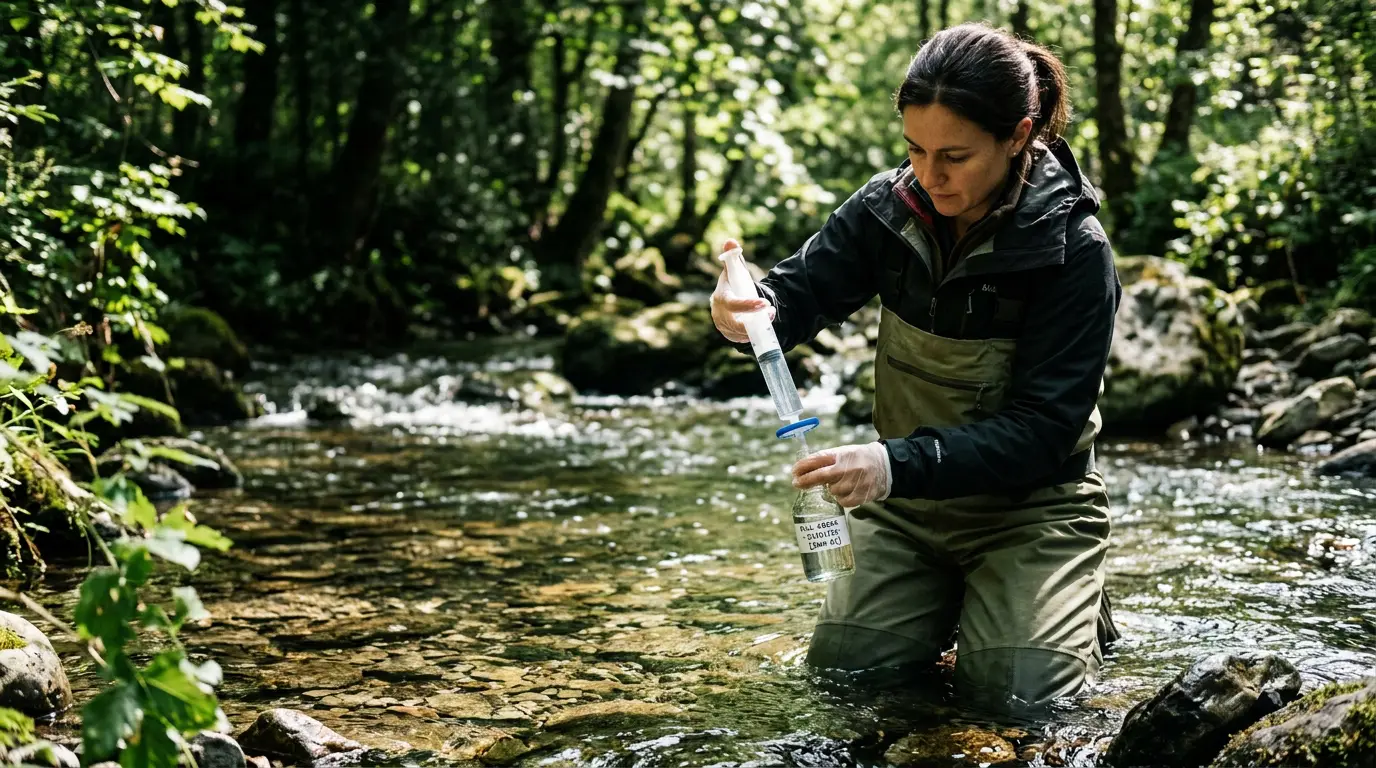
The operational mechanics of an eDNA survey are a marriage of field ecology and cutting-edge molecular biology. The first step, sample collection, is deceptively low-tech. A researcher might wade into a stream to fill a sterile bottle, use a specialized corer to pull up a plug of soil, or deploy a high-powered vacuum to trap airborne particles. The critical stage is avoiding contamination; a single stray skin cell from the researcher could obscure the faint signals they are hunting for. Back in the lab, the sample is filtered to concentrate any biological material. From this filtered residue, scientists extract the DNA.
This raw genetic soup contains DNA from thousands of organisms. The challenge is finding the signal in the noise. Scientists use a technique called polymerase chain reaction (PCR), specifically a method known as 'metabarcoding'. They target short, standardized regions of DNA that vary reliably between species—the 'barcodes'. The process involves 'primers', tiny synthetic DNA strands designed to latch onto the barcode region of a specific group of organisms, for example, all vertebrates or all insects. The PCR machine then makes millions of copies of only these targeted barcodes. These amplified DNA fragments are fed into a high-throughput sequencer, which reads the genetic code of every fragment. Finally, these sequences are compared against vast, curated genetic libraries, like the National Center for Biotechnology Information's GenBank, to identify which species were present in the original sample.
The result is a detailed, and often surprising, list of species. An analysis of a single litre of lake water might reveal not just the common fish species, but also the rare salamander living under a submerged log, the mink that drank from the shore an hour ago, and the eagle that flew overhead. It provides a holistic snapshot of the biological community, revealing interactions and presences that would take traditional survey teams months or even years to document, if they could at all.
In the Field: From Theory to Landmark Discoveries
The practical applications of eDNA have exploded across the globe, solving long-standing conservation challenges. One of the earliest and most impactful uses has been in the detection of invasive species. Before eDNA, managers had to wait for an invasive organism to become established and numerous enough to be physically caught—by which point, eradication is often impossible. In the Great Lakes of North America, eDNA analysis of water from Chicago-area waterways provided the first evidence that the invasive Asian carp, a profound threat to the lakes' ecosystem, may have breached electronic barriers designed to contain them. This early warning system allows for rapid response measures, transforming management from reactive to proactive.
Similarly, in the United Kingdom, the discovery of a single great crested newt—a protected amphibian—can halt a multi-million-pound construction project pending extensive surveys. These traditional surveys, involving nighttime searches and trapping, are time-consuming and expensive. Today, government agencies have approved the use of eDNA testing of pond water as a standard method. A negative water sample can clear a project to proceed in days rather than months, while a positive sample confirms the newt's presence with high certainty, focusing conservation efforts where they are truly needed. It streamlines regulation, saves money for developers, and provides more reliable protection for the species.
“We've moved from searching for a needle in a haystack to analyzing the entire haystack for the needle's metallic signature. It's a paradigm shift in our ability to perceive the living world.”

The technique scales magnificently, from ponds to entire oceans. Marine biologists are now using eDNA to track the movements of migratory giants like whale sharks and mysterious deep-sea dwellers like the oarfish. By sampling water at different depths and locations, they can map species distribution without disruptive and costly ship-based visual or acoustic surveys. This rich data is invaluable for designing effective Marine Protected Areas (MPAs), ensuring that they are located where biodiversity is actually concentrated, not just where it is convenient to place them.
| Metric | Traditional Survey (e.g., netting, trapping) | eDNA Survey |
|---|---|---|
| Detection of Rare Species | Low to Moderate | High to Very High |
| Invasiveness / Animal Stress | High (capture, handling, potential injury) | None (non-invasive water/soil sampling) |
| Time & Labor (per site) | High (often multiple days, several staff) | Low (typically <1 hour for collection, 1-2 staff) |
| Taxonomic Breadth | Limited (method-specific, e.g., nets for fish) | Broad (can detect all kingdoms in one sample) |
| Cost per Detection | High, especially for elusive species | Low, due to higher detection probability |
The Challenges of an Invisible Science
For all its power, eDNA is not an infallible oracle. Its sensitivity is both its greatest strength and a potential weakness, creating a new set of challenges for ecologists to navigate. The primary issue is interpreting what a positive result truly means. DNA degrades in the environment due to UV light, microbial action, and water chemistry. A positive hit confirms a species was present, but it can be difficult to ascertain when. Was the DNA shed minutes ago by a living animal, or is it a lingering trace from a carcass washed downstream days ago? This temporal uncertainty—the 'liveness' problem—means that eDNA tells you 'what' and 'where' with great accuracy, but the 'when' and 'how many' are much fuzzier.
The question of abundance is the current holy grail for eDNA researchers. While some studies show a correlation between the quantity of eDNA detected and the biomass of a species in a controlled environment (more fish equals more DNA), this relationship is complex in the wild. A single large animal might shed more DNA than several smaller ones. Water currents can concentrate DNA from upstream, creating a false impression of high local abundance. While quantitative PCR (qPCR) can measure the amount of DNA present, translating that figure into a reliable population count is a work in progress. For now, eDNA is an exceptional tool for determining presence and absence, but less so for census-taking.
Furthermore, the risk of contamination is ever-present. Labs that process eDNA samples must operate under conditions as stringent as a forensic cleanroom. A single misplaced fleck of dust from another sample, or even DNA from a lab technician's seafood lunch, could lead to a catastrophic false positive, potentially triggering costly and unnecessary management actions. This necessitates rigorous protocols, including the use of negative controls and independent verification, to ensure the data is trustworthy. As the technology becomes more widespread, maintaining these high standards will be a critical challenge.
Growth of eDNA in Scientific Literature
The Future of Seeing the Unseen
The field is advancing at a breathtaking pace, pushing the boundaries of what can be detected. Scientists are now perfecting methods for capturing and analyzing airborne eDNA, opening a new window into terrestrial ecosystems. Imagine being able to create a species list for a dense, inaccessible rainforest canopy simply by analyzing the air that flows through it. Researchers are also exploring 'sedimentary ancient DNA' (sedaDNA), drilling deep into lakebeds and ocean floors to resurrect the genetic ghosts of ecosystems from thousands of years ago, providing a baseline of biodiversity before significant human impact.
Technology is also poised to bring eDNA out of the specialized lab and into the field. Development is underway on portable, automated sequencers, like the Oxford Nanopore MinION, that could one day provide real-time species detection. A ranger patrolling for illegal logging could test a river for the DNA of protected fish on the spot. Automated sampling stations could be deployed in remote ecosystems, acting as biological weather stations that provide a constant data stream on the health and composition of the community.
As with any powerful technology, the rise of eDNA asks us to reconsider our relationship with the natural world. It grants us an unprecedented level of surveillance over life's most secret affairs. The power to know exactly what lives where carries with it a profound responsibility to act on that knowledge. Environmental DNA is not a panacea for the biodiversity crisis. It cannot, by itself, stop a poacher's snare, halt a bulldozer, or cool a warming ocean. But it provides something conservation has desperately needed: clarity. In a world of finite resources and accelerating threats, eDNA allows us to see the unseen, to manage what we can finally measure, and to focus our efforts with a precision that was, until now, the stuff of science fiction.