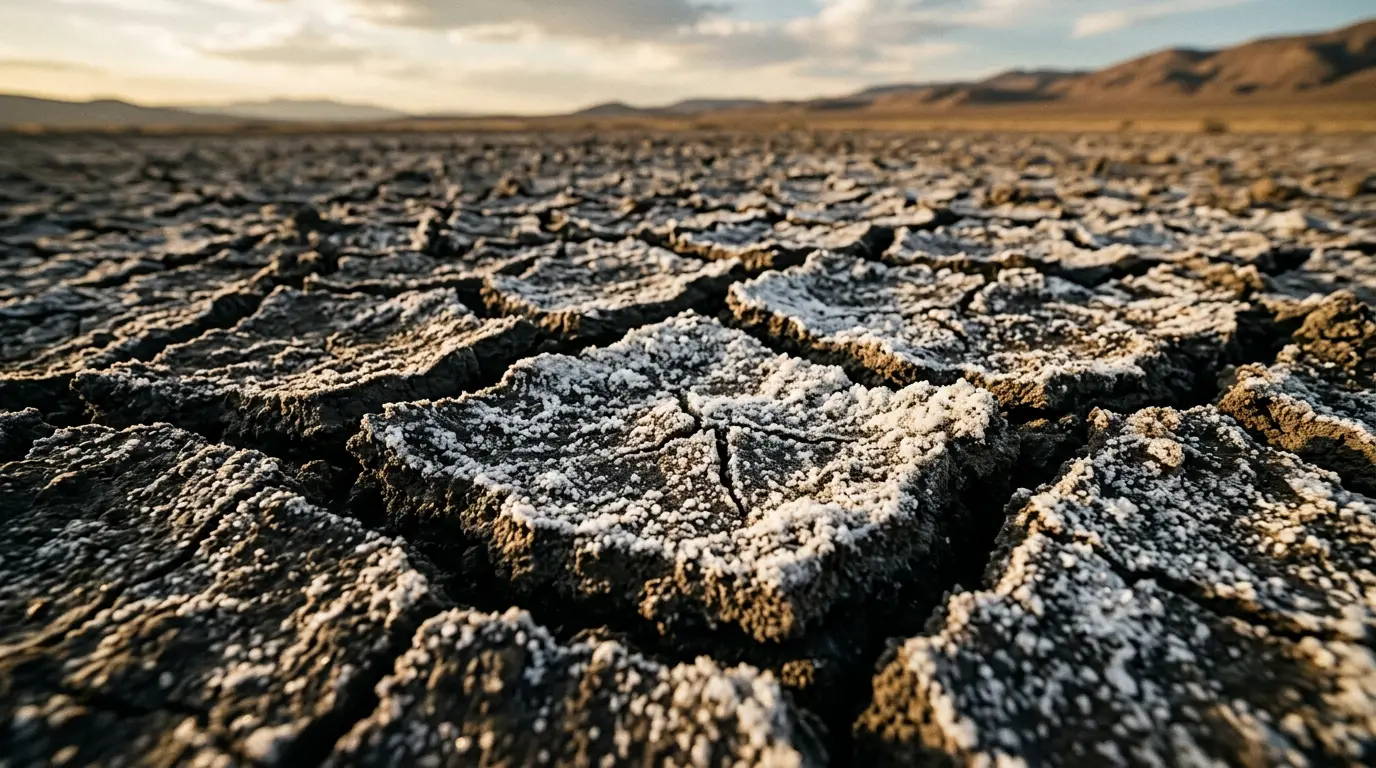
From the air, the fields surrounding Faisalabad in Pakistan’s Punjab province look like a dusty chessboard, marred by ghostly white squares. On the ground, farmers walk through fields where cotton and wheat once flourished, their boots now crunching on a brittle crust of salt. This is not a biblical blight or a freak weather event; it is the slow, creeping outcome of modern agriculture’s original sin. Decades of intensive irrigation, often with brackish groundwater, coupled with poor drainage and heavy use of synthetic fertilizers, have created a chemical imbalance in the soil. Water evaporates under the punishing sun, but the dissolved salts it carries are left behind. Year after year, they accumulate, until the very earth becomes toxic to the crops it is meant to sustain.
This phenomenon, known as soil salinization, is a silent, expanding crisis. According to the UN’s Food and Agriculture Organization (FAO), more than 20% of the world’s irrigated land is already salt-affected, an area larger than the entire landmass of France. Every day, another 2,000 hectares of farmland—enough to feed thousands of people—are lost to salinization. The problem hotspots read like a list of humanity’s most vital breadbaskets: California’s Central Valley, the Indo-Gangetic Plain in India, Australia’s Murray-Darling Basin, and the Nile Delta in Egypt. In each of these regions, the delicate equilibrium that has supported agriculture for millennia is being undone, threatening livelihoods and global food security.
I. The Anatomy of a Poisoned Field
Understanding salinization requires seeing soil not as inert dirt, but as a complex, living system. Healthy soil has a porous structure that allows water to percolate downwards, carrying salts away from the root zone. However, several modern practices disrupt this process. The primary culprit is often irrigation itself. When arid or semi-arid regions are developed for agriculture, water is diverted from rivers or pumped from underground aquifers. This water, unlike pure rainwater, invariably contains dissolved salts. Without adequate drainage to flush these salts out of the system, they concentrate in the topsoil.
This process is exacerbated by high evaporation rates, which act like a distillation process in reverse, leaving the salt behind. Furthermore, the overuse of synthetic fertilizers, particularly those high in potassium chloride or ammonium sulphate, adds to the soil's salt load. The result is a dual-pronged attack on plant life. First, the high salt concentration in the soil creates an osmotic imbalance, making it harder for plant roots to absorb water—a phenomenon often called 'physiological drought,' where plants can wilt and die even in moist soil. Second, the accumulation of specific ions, such as sodium and chloride, can be directly toxic to plants, scorching leaves and stunting growth.
In coastal regions, the threat comes from a different direction but with the same result. Over-extraction of freshwater from coastal aquifers lowers the water table, allowing seawater to intrude inland. Rising sea levels, a direct consequence of climate change, push this saltwater frontier further into deltas and low-lying agricultural plains, rendering vast tracts of fertile land unusable for conventional crops like rice and corn.
II. The Limits of an Engineering Fix
For decades, the standard response to salinization has been a war of brute force, fought with engineering and massive inputs of freshwater. The most common remediation technique is 'leaching,' which involves flooding fields with large quantities of low-salinity water to wash the accumulated salts deeper into the soil profile, below the root zone. This is often paired with the installation of complex and costly subsurface drainage systems—networks of perforated pipes laid deep in the earth to carry the saline effluent away.
While these methods can be effective in the short term, they are deeply problematic. Leaching requires colossal volumes of freshwater, a resource that is increasingly scarce in the very arid regions where salinization is most rampant. It presents a profound paradox: the solution demands more of the same resource that, when mismanaged, caused the problem. For millions of smallholder farmers in developing nations, the cost of installing and maintaining sophisticated drainage systems is simply prohibitive, locking them out of the solution.
“We've been treating salinity as a plumbing problem, thinking we can just flush it away. But we're realizing that you cannot endlessly fight chemistry with engineering. The solution isn't just about moving salt; it's about changing the biological and ecological context of the farm itself.”
Moreover, these engineering fixes often just displace the problem. The saline drainage water must go somewhere. In many cases, it is discharged into rivers, wetlands, or evaporation ponds, where it can contaminate surface water, harm aquatic ecosystems, and create sacrifice zones of extreme salinity. It's a classic 'end-of-pipe' solution that fails to address the root cause and creates a cascade of new environmental challenges.
III. A Radical Re-think: Farming with Salt

Faced with the limits of conventional remediation, a growing coalition of scientists, agronomists, and farmers is proposing a radical shift in perspective: instead of trying to remove salt from the farm, why not adapt the farm to the salt? This is the core premise of 'saline agriculture,' an approach that moves away from fighting the environment and towards working within its constraints.
This approach is not entirely new. Coastal communities have foraged for and cultivated salt-tolerant plants for centuries. What is new is the systematic, scientific effort to identify, breed, and integrate these crops into modern agricultural systems. At the forefront of this work is the International Center for Biosaline Agriculture (ICBA), headquartered in the hyper-arid landscape of Dubai. For over two decades, its scientists have travelled the world, collecting seeds of halophytic plants from salt marshes, deserts, and coastal plains. Their gene bank now holds thousands of accessions of plants that most of the world has written off as weeds.
The results are beginning to transform previously barren landscapes. On test farms from Egypt to Uzbekistan, ICBA and its partners are demonstrating that highly salinized land and water can be used to grow crops like quinoa, salt-tolerant barley, and pearl millet. These are not just niche products; they are nutrient-dense grains and forages that can support local food systems and create economic value. In coastal Bangladesh, where saltwater intrusion has devastated rice paddies, farmers are now cultivating Salicornia, a crunchy, salty vegetable prized by chefs, which they can grow using the same brackish water that killed their rice.
IV. Integrating Solutions: The Regenerative Toolkit
Simply swapping one crop for another is not the whole story. The most promising strategies integrate saline agriculture with the principles of regenerative farming to heal the soil itself. The goal is to restart the soil’s natural biological engine to improve its structure and resilience. This approach recognizes that a healthy, living soil is better equipped to manage salt stress.
Key regenerative techniques are proving remarkably effective. The application of compost and other organic matter is crucial. Humus, the stable form of carbon in compost, acts like a sponge, improving water infiltration and retention. More importantly, organic molecules can bind with sodium ions, a process called chelation, which effectively 'locks up' the salt and makes it less available for plant uptake. This reduces the osmotic stress on crops.
Similarly, the use of cover crops—specifically salt-tolerant species planted between cash crop cycles—protects the soil surface from erosion and reduces evaporation, which is the primary driver of salt accumulation at the surface. Their roots create channels that improve soil structure and drainage, while their decomposition adds valuable organic matter. When combined with no-till practices, which eliminate ploughing to preserve soil structure and fungal networks, these methods create a virtuous cycle of soil health improvement.
| Metric | Conventional Leaching & Drainage | Saline Agriculture & Regenerative Practices |
|---|---|---|
| Upfront Cost per Hectare | High ($1,500 - $4,000 for subsurface drainage) | Low to Moderate ($100 - $500 for seeds, compost) |
| Annual Freshwater Requirement | Very High (up to 15,000 cubic meters per hectare) | Low to None (utilizes brackish water or improved retention) |
| Impact on Biodiversity | Negative (effluent pollutes waterways, monoculture focus) | Positive (increases plant diversity, improves soil life) |
| Long-term Soil Fertility | Often declines due to loss of nutrients and structure | Increases through addition of organic matter and microbial activity |
| Farmer Autonomy | Low (dependent on large infrastructure and water rights) | High (relies on local resources and ecological knowledge) |
This integrated approach offers a pathway for restoring productivity to land once considered lost. Instead of a single, expensive silver bullet, it is a portfolio of adaptable, low-cost strategies that empower farmers. It represents a fundamental shift from a mindset of control and extraction to one of co-creation and stewardship.
Projected Global Area of Salt-Affected Cropland
The challenge of soil salinization is immense, woven into the complex tapestry of climate change, water scarcity, and population growth. There is no easy fix. Yet, on the salt-crusted edges of our agricultural world, a quiet revolution is taking root. By looking to nature's own innovators—the hardy halophytes—and rediscovering the timeless wisdom of building healthy soil, we may yet find a way to turn barren fields back into productive landscapes. It is a long, patient work of healing, not of conquering, and it offers the most credible hope we have for securing a future on an increasingly salty planet.
Frequently Asked Questions about Soil Salinization and Remediation
Can saline agriculture be integrated with conventional farming systems?+
Yes, saline agriculture can be integrated with conventional systems. For instance, crops with different salt tolerances can be rotated, allowing for the use of traditional, less salt-tolerant crops in less saline areas.
How does climate change exacerbate soil salinization?+
Climate change contributes to soil salinization through increased evaporation, changes in precipitation patterns, and rising sea levels, which can lead to saltwater intrusion in coastal areas (IPCC, 2021).