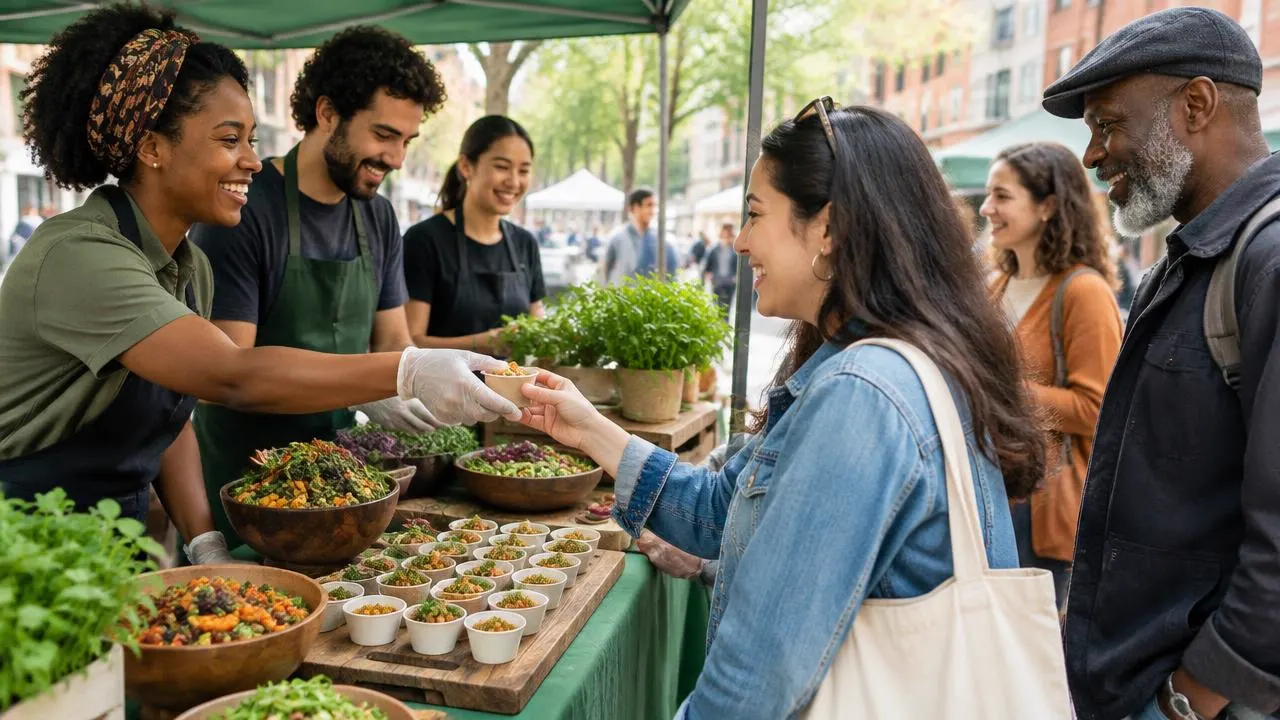
For the animals. For the planet. For each other.
A kinder world starts on your plate.
More than 80 billion land animals — and trillions of marine animals — are killed for food every year. Choosing plants is the single largest lever most of us have to make the world less cruel, cooler and greener.
Since you opened this page
0
land animals killed for food worldwide
0
fish & marine animals killed worldwide
The problem
The quiet cost of how we eat
Most of this happens behind closed doors. The farms have no public address, the trucks travel at night, and the slaughterhouses sit on the edge of towns we never visit. By the time the meat reaches the plate, it is unrecognisable. This isn't an accusation — it's an invitation. When people see clearly, they choose differently.
Four reasons
Why people make the shift
For the animals
Over 80 billion land animals — and trillions of aquatic animals — are killed for food each year. Most never see the sun. Choosing plants withdraws our consent from a system most of us would never approve of in person.
For the planet
The largest study of food systems (Poore & Nemecek, Science 2018) found that moving to a plant-based diet is the single biggest action an individual can take to reduce environmental impact — cutting food-related land use by 76% and emissions by up to 49%.
For your health
Decades of research — Adventist Health Studies, EPIC-Oxford, PREDIMED — keep landing on the same conclusion. People who eat mostly plants live longer, with less heart disease, less type-2 diabetes, and lower rates of several cancers.
For each other
A third of the world's grain is grown to feed farmed animals. Redirected to humans, it could nourish billions more people. Plant-based food systems are simply more efficient — and a fairer way to share a finite planet.
By the numbers
Is plant-based really better for the planet?
80%
of global farmland is used for animal agriculture
26%
of global greenhouse-gas emissions come from food systems
27%
of freshwater goes to livestock and their feed
80%
of Amazon deforestation is linked to cattle
Sources: Poore & Nemecek, Science (2018); Crippa et al. (2021); FAO; Mekonnen & Hoekstra water-footprint estimates.
Voices
A movement of quiet conviction
“The question is not, 'Can they reason?' nor, 'Can they talk?' but rather, 'Can they suffer?'”
“A plant-based diet is probably the single biggest way to reduce your impact on planet Earth.”
Your pocket ally
VeggieOS — the free app that makes going vegan easy.
Scan any food, cosmetic or household product and see instantly whether it's vegan, vegetarian and cruelty-free. Get plant-based alternatives when it isn't, plus a recipe converter, weekly meal planner, pantry tracker and personal impact dashboard.
- Barcode scanner for ingredients & cruelty-free status
- Meal planner, recipes & pantry tracker
- See your real animal, water, land & CO₂e impact
100% free — no ads, no tracking.
Join us
Small choices, built into habits, become a movement.
Real change rarely arrives in one dramatic moment. It accumulates — meal by meal, label by label, conversation by conversation. Take the next honest step you can. We'll meet you there.
Unganisha hatua na ushahidi
Ulinzi wa wanyama unategemea uchaguzi wa mtu binafsi na mabadiliko ya kitaasisi. Angalia kile kampeni inachoomba, wanyama gani inayoathiri na jinsi maendeleo yatakavyopimwa. Ushauri wa lishe unapaswa kuzingatia hatua ya maisha na mahitaji ya mtu binafsi.
Vyanzo vya marejeleo