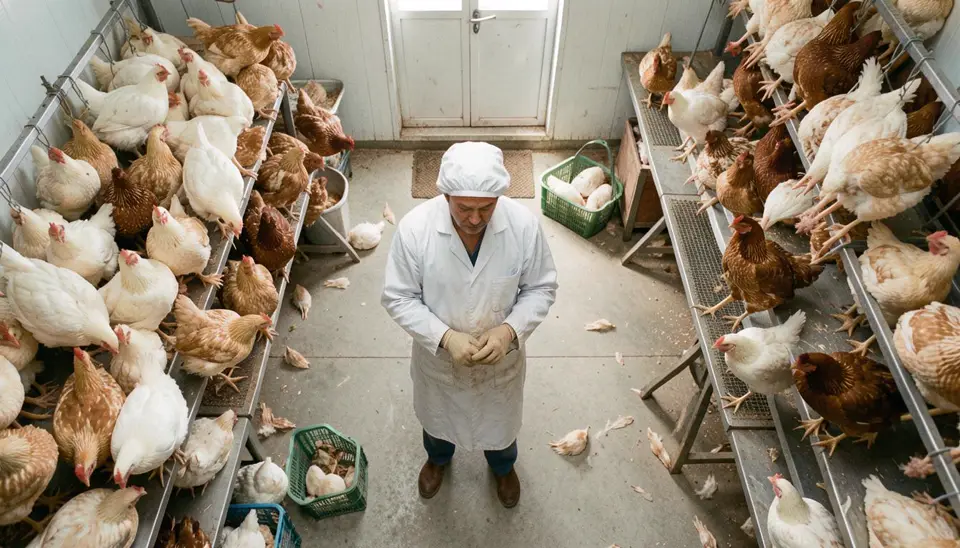
Battery cages, long criticized for their impact on animal welfare, are increasingly under scrutiny from investors worldwide. In East Asia, shareholder pressure is mounting on corporations to phase out these confined living spaces for millions of chickens.
Colony cages, also known as battery cages, are a common feature of industrial poultry farming worldwide. These small, wire-mesh enclosures are typically stacked in large numbers, housing 3-4 chickens each. The cages are designed to maximize egg production but limit the birds' ability to engage in natural behaviors such as nesting, perching, or dustbathing.
How shareholder pressure works
Shareholder resolutions are proposals submitted by investors, encouraging corporations to adopt specific policies or practices. In the case of battery cages, resolutions often call for companies to set phase-out targets, adopt cage-free policies, or improve animal welfare standards.

Investors file these resolutions during a company's annual general meeting, with the support of a minimum number of shares. If a resolution receives a significant level of support (typically around 30% or more), it sends a strong signal to the company's board and management that change is needed.
Investor concerns driving change
“The reputational risk associated with intensive farming practices is increasingly a concern for investors. Our clients are looking for companies that align with their values and demonstrate strong environmental, social, and governance (ESG) practices.”
Concerns about reputational risk, animal welfare, and ESG performance are driving investors to engage with corporations on battery cage usage. As awareness grows, so does the pressure on companies to adopt more humane farming practices.
| Corporation | Country | Resolutions Filed (2020-2023) | Percentage Supporting Resolution |
|---|---|---|---|
| AgriTech Holdings | South Korea | 4 | 35% |
| FoodCorp Industries | Japan | 6 | 42% |
| Animal Products Ltd. | Taiwan | 3 | 38% |
| MeatPro Co., Ltd. | China | 5 | 32% |
Regional progress and challenges
While shareholder pressure is mounting across East Asia, progress varies by region. Some countries, like Japan and South Korea, have seen a higher number of resolutions and greater investor engagement. Others, such as China, lag behind due to limited transparency and investor access.
Support for shareholder resolutions on battery cages, by country (2020-2023)
Despite regional differences, the trend towards cage-free systems is clear. Investors, consumers, and animal welfare advocates are increasingly demanding change, pushing corporations to adopt more humane farming practices.
Industry response and next steps
While some corporations have committed to phase out battery cages, others remain resistant to change. Investors, NGOs, and consumers must continue to engage with these companies, raising awareness and pushing for policy improvements.
Frequently asked questions
What are the main alternatives to battery cages?+
Enriched cages, free-range systems, and organic farming are some of the alternatives to battery cages. Each has its own implications for animal welfare, environmental impact, and production costs.
How can consumers support the transition to cage-free systems?+
Consumers can support the shift by choosing cage-free products, engaging with corporations on social media, and signing petitions calling for better animal welfare standards.
What role do governments play in promoting cage-free systems?+
Governments can play a crucial role by setting animal welfare standards, providing incentives for cage-free production, and encouraging public procurement of cage-free eggs and meat.